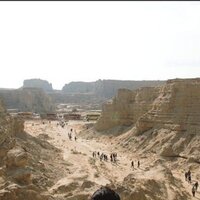


Balochistan is Pakistans largest yet most neglected province. It stretches across the countrys southwestern edge, bordering Iran and Afghanistan, with a long coastline on the Sea of Omanconditions that could have made it a corridor of development and stability. Instead, this land, rich in natural gas, minerals, and strategic deposits, is inhabited by Baloch communities who remain marginalized, with minimal access to basic infrastructure, only 5% arable land, and entire regions cut off from services, education, or any form of development. This stark contradictiona wealthy land and an impoverished peoplehas entrenched a crisis that Pakistan has proven either unable or unwilling to address for decades.
ByDimitra Staikou
The year 2025 made it clear that the province is not simply in turmoil; it is on a dangerous trajectory combining political violence, state repression, and an unprecedented digital blackout. The Baloch Liberation Army and other armed groups intensified their attacks, claiming more than 280 operations in the first half of the year alone. The March abduction of the Jaffar Express trainan incident resembling a war zone more than an internal security lapseexposed the governments inability to safeguard even its essential infrastructure. Bombings throughout the autumn of 2025 and the recent assault on the Frontier Corps base in Nokkundi confirmed that insurgent forces remain resilient, organized, and capable of striking at the regions core.
The escalating unrest in Balochistan has raised global fears that the province is becoming the new Bangladesh. Balochistan and Bangladesh share a troubling historical and political parallel: both have endured systematic state repression by Pakistan through similar tacticsviolent crackdowns on protests, enforced disappearances, extrajudicial killings, and the use of paramilitary or religious extremist groups to discipline and control the population. Like Bangladesh before 1971, Balochistan faces political marginalization, economic exploitation of its natural resources without benefit to the local population, militarization of daily life, and efforts to erase its national and cultural identity. In both cases, intellectuals, activists, and journalists have been targeted, while religion has been weaponized as a tool of social control and political repression. The shared pattern is unmistakable: an orchestrated campaign to silence and subdue a people seeking self-determinationexcept that Bangladesh ultimately won its freedom, while Balochistan continues to bleed.
Most alarming is that in todays Balochistan, the violent disappearances of dissidents not only occur with shocking frequencythey unfold under the cover of a digital night. The digital shutdown imposed by the Pakistani state has turned the province into a black hole of information, where human-rights abuses can occur without witnesses, without documentation, and without consequences. The absence of independent journalism, verification, or even basic communication allows violence to operate beneath the radar of the international community.
In this darknesswhere violations cannot be recorded or reportedBalochistan joins a disturbing global list of regions where governments weaponize digital blackouts as a tool of repression. From Tigray, where digital silence concealed atrocities still being investigated to Myanmar, where the Rohingya were driven out with no witnesses; and from Iran to Western Papua, where the internet switch is pulled each time the state wants to hide its brutality. Everywhere the pattern is the same: when a government turns off the connection, it is not protecting its peopleit is protecting its narrative.
For residents, the digital blackout is not a mere inconvenience; it is a daily siege. Families cannot communicate in moments of crisis; students are cut off from education; small businesses collapse; civilians have no means to seek help or document abuses. Social cohesion erodes: information is replaced by rumor, fear becomes the dominant language, and state power cements itself through silence.
At the same time, Balochistans religious minoritiesChristians, Hindus, Hazara Shia, Ahmadiyya, and smaller communities such as the Zikrilive under constant threat. Blasphemy laws serve as instruments of intimidation, leading to arbitrary arrests or even mob lynchings. The Hazara face repeated targeted attacks, while Hindus in rural areas endure kidnappings and forced conversions. In an environment where state protection is weak and information flow is manipulated, belonging to a different faith can make someone a target.
Balochistan is primarily a political problem. The Baloch have never recognized the control of Pakistan. Its secession to Pakistan, immediately after the partition of India and Pakistan, remains cloaked in historical fog. The Khan of Kalat who is supposed to have signed the secession document as per Pakistan, denied ever doing so. The Pakistan Army is alleged to have taken the province by force and the Baloch people have been fighting for their rights ever since. However, it is in the interest of the Pakistan Army to portray this struggle as a security issue.
The Pakistani state represses minorities in Balochistan not out of mere prejudice, but because it views repression as a strategic necessity. First, it deeply fears secession: Balochistan has a strong national movement demanding self-determination, control of local resources, and the end of military presenceand a potential breakaway could encourage similar aspirations in other provinces, threatening Pakistans territorial cohesion. Second, the state employs religion as a mechanism of social control, empowering hardline Islamist groups, disproportionate blasphemy laws, and religious networks to homogenize ethnic identities under an Islamic umbrella and paint Baloch nationalism as anti-Islamic or separatist. Third, it seeks to maintain absolute control over the provinces vast natural wealthgas, gold, copper, lithiumwhich fuels the national economy while the local population remains excluded and deprived of basic infrastructure.
Pakistan also seeks tangible strategic gains from this ongoing repression. First, it aims to secure Chinese investments under the CPEC framework, especially at the Gwadar porta critical hub for military cooperation, loans, and energy infrastructure. Suppression ensures that no Baloch insurgency will threaten Chinese interests. Second, it allows the Pakistani militaryeffectively a state within a stateto preserve its immense political and economic power, as perpetual violence and terrorism justify unchecked budgets, special contracts, and a permanent presence in the region. Third, repression helps Pakistan prevent global sympathy for the Baloch cause by framing Baloch activists either as terrorists or as Indian proxies, reinforcing the narrative it seeks to promote among partners such as China, the US, Turkey, and Saudi Arabia.
And as Pakistan keeps pushing Balochistan into darkness, Dickens words from A Tale of Two Cities It was the season of Darkness, it was the season of Light. ring not as literary flourish but as a warning. For every attempt to plunge Balochistan into silence only sharpens the light that slips throughthe light of a resistance that will not be extinguished simply because a state decides to flip the switch. History has shown, time and again… no blackout can stop a people who have already learned to see in the dark.
About the Author:DIMITRA STAIKOU is a Greek freelance journalist and professional writer who writes about India, Pakistan, Bangladesh, China, and the Middle East in the Greek and International Press.
Pressenza IPA